
The Drone Thrust Test Bench: Engineering Precision for the Next Generation of UAV
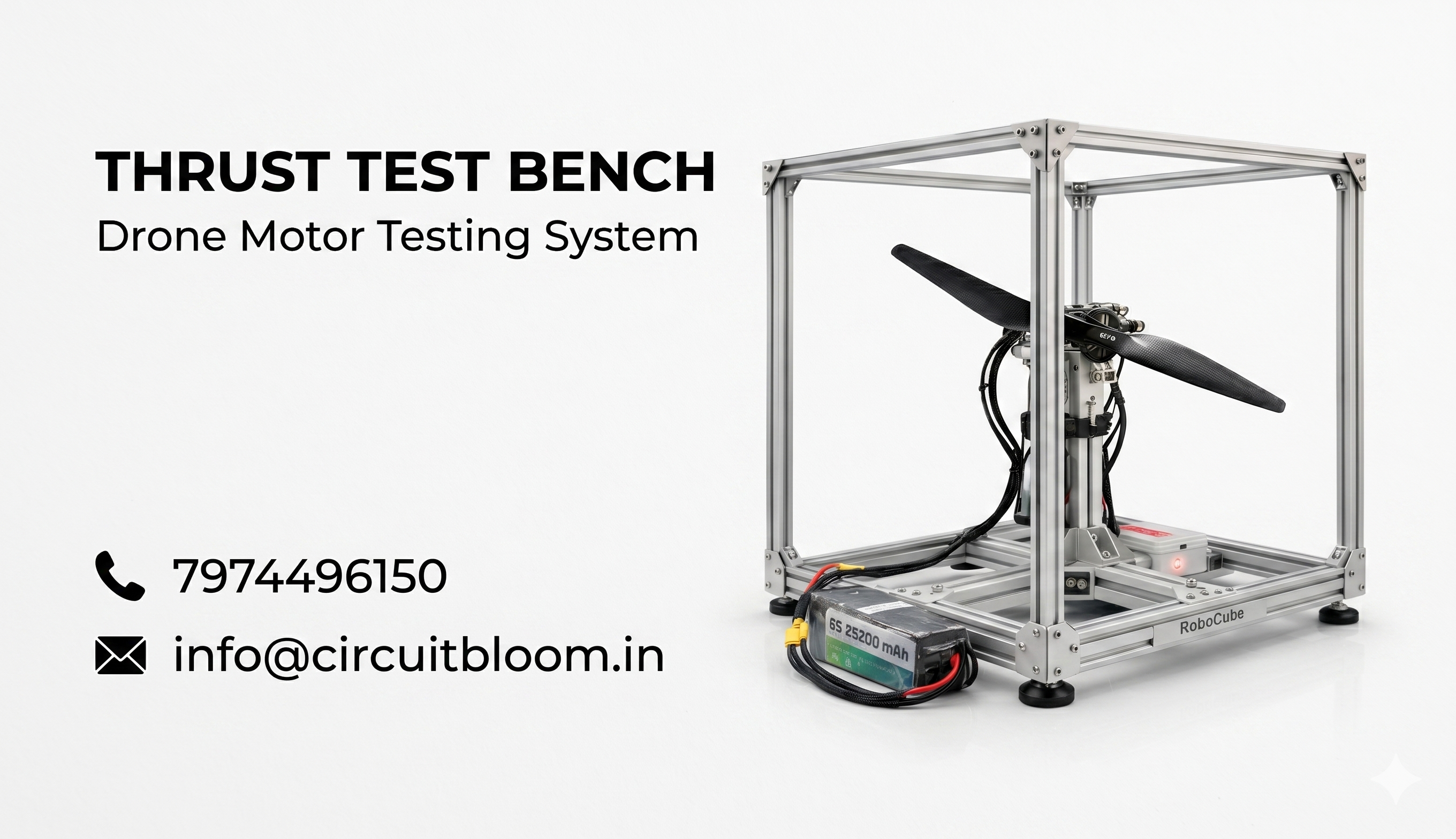
What Is a Drone Thrust Test Bench?
A drone thrust test bench — also called a motor thrust testing system or thrust stand — is a precision mechatronic instrument designed to measure, log, and analyze the performance characteristics of drone motors, propellers, and ESC (electronic speed controller) combinations under controlled, repeatable conditions.
In the aerospace and UAV industry, every gram of thrust matters. Whether you're developing a next-generation delivery drone, a long-endurance surveillance platform, or a racing quadcopter, the only way to validate your propulsion system with scientific confidence is through a dedicated propeller testing machine that removes guesswork entirely.
At Circuit Bloom Technologies, our drone thrust test bench is engineered to the same exacting standards as aerospace component validation rigs — delivering laboratory-grade accuracy at the engineering lab and production floor level.
Why Thrust Testing Is Non-Negotiable in Modern UAV Development
The drone industry is no longer a hobbyist space. With commercial UAV applications spanning defense, agriculture, logistics, infrastructure inspection, and emergency response, the performance and reliability stakes have never been higher. Inadequate propulsion testing is one of the leading causes of mission-critical failures in UAV deployments.
A dedicated UAV testing system like the Circuit Bloom thrust bench addresses fundamental engineering questions that simulation alone cannot answer:
- ✓ What is the actual static thrust produced by a motor-propeller pair at a given voltage and throttle setting?
- ✓ How does thrust degrade as motor temperature rises during sustained operation?
- ✓ What is the power-to-thrust efficiency ratio (grams of thrust per watt) across the full RPM range?
- ✓ How does propeller pitch and diameter affect torque, vibration, and current draw?
- ✓ Are two motors from the same batch performing identically — or is there unit-to-unit variance affecting flight stability?
These are not theoretical concerns. In a multi-rotor UAV, even a 3–5% imbalance between motor outputs can introduce persistent yaw drift, reduce payload capacity, and shorten battery life significantly. A high-precision drone motor test stand transforms these unknowns into quantified data.
"In aerospace engineering, data is not just information — it is the foundation of trust. Every flight begins with a measurement made on the ground."
Key Parameters Measured by the Circuit Bloom Test Bench
Our motor thrust testing system is built around a comprehensive six-parameter acquisition architecture. Each sensor channel is independently calibrated, temperature-compensated, and sampled at high frequency to capture transient as well as steady-state behavior.
Core Components of the Circuit Bloom Thrust Test System
A professional-grade drone thrust test bench is an integrated system, not a collection of parts. Every subsystem in the Circuit Bloom platform is selected and validated for mutual compatibility, calibration stability, and long-term repeatability.
- 01
Precision Load Cell Assembly The mechanical heart of the system. A temperature-stable, shear-beam or S-type load cell with overload protection and hysteresis below 0.05%, mounted in a vibration-isolated aluminium alloy cradle.
- 02
Motor / ESC Mount (Universal Adapter System) CNC-machined motor mounting plates with standardized bolt patterns accommodate motors from 1103 up to 8010 frame sizes. Quick-swap without recalibration.
- 03
Data Acquisition Unit (DAQ) A multi-channel 16-bit ADC with synchronized sampling across all sensor channels. USB and wireless data output to desktop software. No signal crosstalk or ground loops.
- 04
PWM / DSHOT Throttle Controller Programmable throttle sweep controller enabling automated sweep tests (0–100% throttle in configurable steps) for full characterization curves without manual intervention.
- 05
Circuit Bloom Analytics Software Windows / Linux compatible desktop application with real-time graphing, CSV export, efficiency map generation, and PDF reporting — purpose-built for UAV propulsion engineers.
- 06
Safety Enclosure & Propeller Guard Polycarbonate safety shield designed per ISO 11684 for operator protection during high-RPM testing. Mandatory in any professional UAV laboratory setup.
Applications: Who Uses a Drone Thrust Test Bench?
The Circuit Bloom UAV testing system is deployed across a broad spectrum of professional environments where propulsion data quality is directly linked to product quality, safety certification, or competitive advantage.
Why Engineers Choose Circuit Bloom's Motor Thrust Testing System
In a market crowded with generic load cells and improvised test rigs, the Circuit Bloom drone thrust test bench stands apart on five decisive dimensions:
1. Uncompromised Measurement Accuracy
Our load cell and signal conditioning chain is calibrated against NABL-traceable reference weights. You receive not just a number, but a calibrated, repeatable measurement you can stake a design decision on. Competing test benches using uncalibrated bathroom scales or consumer load cells can introduce errors of 5–15% — unacceptable in any serious engineering workflow.
2. Six-Channel Simultaneous Acquisition
Every parameter — thrust, torque, RPM, voltage, current, and temperature — is sampled synchronously. This is critical for computing derived metrics like Mechanical Power, Electrical Power, Motor Efficiency (η), Figure of Merit, and Thrust-to-Power ratio, which require correlated, time-aligned data.
3. Indian Engineering with Global Standards
Designed, assembled, and calibrated in India, the Circuit Bloom system is engineered to match — and in several key areas, exceed — the specifications of international counterparts at a significantly more accessible price point, supporting the Make in India vision for aerospace self-reliance.
4. Built for Engineers, Not Hobbyists
From the CNC-machined structural frame to the isolated sensor grounds and the professional data software, every design decision reflects the requirements of working engineers — not the constraints of a consumer product roadmap.
5. Full-Stack Support Ecosystem
Circuit Bloom provides post-sale technical support, calibration services, custom motor mount fabrication, and application-specific software configuration — a commitment rarely found from hardware-only suppliers.
The Future of Drone Propulsion Testing
The UAV testing system landscape is evolving rapidly. As drone platforms become more capable and regulatory oversight more rigorous, the requirements placed on propulsion test infrastructure will intensify. Here is how Circuit Bloom is positioning to lead this evolution:
The drone industry is accelerating toward a future where every airworthy propulsion system carries a digital data passport — and the motor thrust testing system is where that passport is created.
Based in India, Circuit Bloom Technologies is a deep-technology engineering company focused on precision measurement systems for the drone and aerospace industry. Our flagship product, the Drone Thrust Test Bench, represents years of applied R&D combining mechanical precision engineering, high-speed data acquisition, and aerospace instrumentation best practices.
We serve drone OEMs, defence research organizations, academic institutions, and UAV startups who share our belief that great drones are built on great data. Our mission is to make laboratory-grade propulsion testing accessible to every serious engineering team in India and beyond.
Get Your Circuit Bloom Thrust Test Bench
Join leading UAV teams across India who trust Circuit Bloom for precision motor and propeller testing. Request a demo, technical datasheet, or custom quotation today.
© 2025 Circuit Bloom Technologies Private Limited · Drone Thrust Test Bench · UAV Testing Systems · Made in India